Ready to help treat your pet to a healthy life?
Introducing Pets to Babies: What to Expect
By : Kathleen Crampton | Published Mar 13, 2026
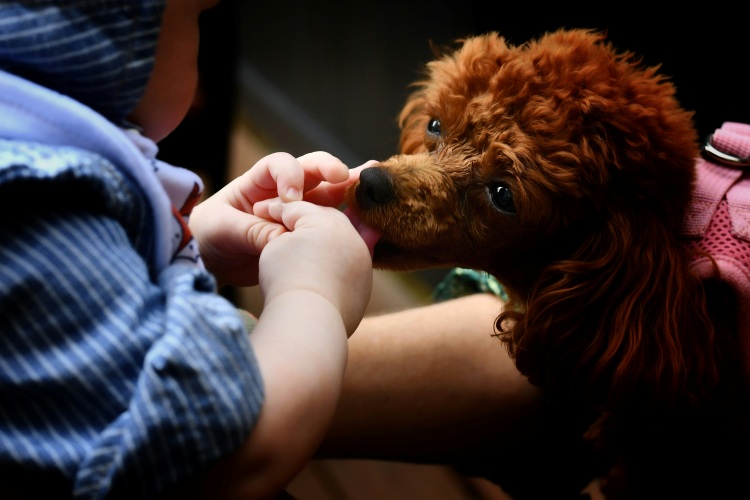
If you're expecting a new bundle of joy, you likely have a lot on your mind, with questions ranging from prenatal care to baby gear to getting a baby room set up. But if you're already a pet parent to a little fur baby, chances are that you're also curious about safely introducing pets to babies. After all, babies come with new sounds and smells that are often unfamiliar to dogs and cats.
We'll walk you through how to introduce a dog or cat to a newborn, showing that with some training and preparation ahead of time, the interaction can be calm, safe, and stress-free.
How can I prepare my pet for a baby?
Don't wait until the day you bring home your newborn to prep your pet—start getting them used to their new surroundings well before baby arrives. Preparing them in advance eases your dog or cat into the upcoming change rather than exposing them all at once, which can cause stress and unwanted behavior.
Starting a few months before you're due to bring the baby home, take the following steps to ease your pet into their soon-to-be new life:
- Introduce them to baby smells. Dogs' and cats' sense of smell is incredible; they have 200 million smell receptors compared to humans' 5 million! They use their noses to help them navigate the world around them, picking up on scents that even we can't. This is why it can be helpful to expose them early on to baby lotions, shampoos, and other fragrant items so that they can get accustomed to the new scents and know that they're safe.
- Play baby sounds. Pets can become agitated with extended, loud cries, something that's common with babies. To desensitize them to these sounds, every now and then, play recordings of a baby crying and cooing while your pet is nearby, rewarding them for staying calm.
- Set up the baby room and gear. Wherever your dedicated baby space is, start setting up the area slowly, including their bassinet or crib, changing table, stroller, and so on. If you have a dog, start training them to not enter the area without your go-ahead, rewarding them for good behavior. You could also set up a baby gate.
- Practice feeding and taking them for walks at different times of day. Any parent knows that consistency can go out the window—at least for a little while—when a newborn arrives. Your dog or cat needs to get used to a hitch in their routine, too. While consistency is important for your pet, try to feed them at a slightly different time, maybe an hour or two before or after their usual feeding, and take them on walks at different times of day. This trains them for the possibility of an early or late walk or meal time. You could even consider getting an automatic feeder.
- Keep their safe space consistent. Dogs and cats can be sensitive to changes in their space, so prioritize their comfort. Make sure that their sleeping area or play space is still their own.
- Start walking your dog with a stroller. You'll likely take both your baby and your dog for a walk at the same time, so let your pup get used to the stroller ahead of time.
- Introduce new rules, if needed. Will your pet no longer be welcome on the couch or bed? Will you have a specific place to feed and hold the baby that your pet isn't allowed near? Perhaps you want to get their jumping under control. This is the time to set boundaries and give your pet the training they need to live peacefully in the new environment.
The day of: how to introduce your pet to your baby

Baby introductions can be intimidating, whether you want to know how to introduce a dog to a newborn or need tips for your cat meeting your baby for the first time. When the time comes, keep the process as simple as possible, following these tips:
- Make sure your pet has expended their energy. Touch base with their caretaker or boarding facility first to ensure that they've been walked or played with.
- Greet your pet first without the baby (or have a partner, family member, or friend do this) so that your dog or cat can give their affection freely. Then, leash your dog or contain your cat while you prepare to show them the baby. (Optional: When you first greet your pet, bring an item that your baby has used recently, like a burp cloth, hat, or onesie. Let your pet sniff the item first before introducing your baby.)
- Ensure that treats are nearby. Introduce your leashed pet to your baby briefly and slowly, perhaps only letting them sniff around for a few seconds. As they approach and sniff, speak calmly, then reward them with a treat.
- Repeat this interaction a few times, always rewarding gentle behavior.
- Never force an interaction. Let your pet approach on their own in a controlled environment. As they gain your trust, you can eventually let them approach without a leash.
Continue to monitor interactions closely, keeping your pet leashed—or contained in your arms—in the beginning, then taking them off leash when they consistently show good behavior. If they show signs of stress, end the interaction, calmly distracting them with a toy or leading them to their safe space, like a crate or bed.
Establishing baby boundaries for your pet
Remember the steps you took in the months prior to baby coming home? To have pets and babies together safely in the same space, continue reinforcing the same training and behaviors with your pet, such as:
- Not letting them enter the baby's room without your consent.
- Respecting the baby's space (e.g., not pawing at the crib or bouncer or at the person holding the baby).
- Gently sniffing the baby.
- Not jumping on furniture, such as the couch or your bed.
- Responding to "sit" or "down" when you're walking around with or feeding the baby.
These are just some examples of boundaries that you might maintain with your pet. Always use positive reinforcement with training, such as praise or treats. It also may be helpful to use a baby gate around sensitive areas, like a play space, a dedicated feeding area, or the nursery.
What are some safety tips for pet and baby interactions?

Prioritizing baby and pet safety is paramount. Keep the following in mind when managing interactions:
- Meetings should be with the baby in your arms, in a car seat, or in the crib.
- Introducing pets and babies should only happen when both are calm.
- Until you can trust that your pet won't react negatively to the baby, keep a leash on them and hold it loosely as they approach.
- Never leave pets and babies together unsupervised. Train your pet to follow you when you leave the baby.
- Try to situate yourself—or whoever has the baby—between the pet and the baby, separating them and minimizing any reactions.
Remember that your pet may take time to get used to their new human family member. If you notice signs of pet anxiety or aggression, calmly remove your pet from the area, taking them to their safe space or playing with them in another room. Then, reward them once they calm down. Try another introduction when both your baby and pet are calm. If your pet shows any unwanted behavior, remove them again and call your veterinarian.
Adjusting to life with your pet and new baby
Introducing pets and babies is just the beginning of your exciting journey. As you settle into your new life as both a pet and baby parent, give yourself grace and remember that everyone needs some time for adjustment—your pet included!
You'll likely need to adjust your pet's routine to align it with the baby's schedule, and you may not be able to give your furry companion as much dedicated one-on-one time as you used to. Try to give them love and attention throughout the day, incorporating any time you have to play with them, go on walks, and cuddle. You can do some of these activities even while holding your baby and maintaining safety precautions.
If you notice concerning pet behavior after baby, be sure to speak with your veterinarian or find a professional trainer who can help your pet learn how to coexist peacefully with their new sibling.
You can also reference online resources, such as Trupanion's Pet Parenting blog, to learn more about dog and cat behaviors, training tips, and more. And don't forget to sign up for pet insurance for peace of mind in case of unexpected events. After all, you've already got a lot on your mind, so take this opportunity to sign up for Trupanion coverage so that you can focus on your new addition.
Pet Parenting is the official dog and cat blog of Trupanion, a leader in the world of pet insurance. Here you’ll find useful dog and cat care tips, important veterinary insights, and an abundance of pet lifestyle topics. All of our articles are written by real humans with a love for pets, not AI. However, please note that the views expressed here are those of the individual authors and do not necessarily reflect those of Trupanion. Articles are reviewed by veterinarians for accuracy, but they are not a substitute for professional diagnosis and treatment. Always consult with your own pet’s veterinarian for advice.